Have you ever looked in the mirror and felt like your skin changed overnight? One day, it’s a tiny fine line, and the next, your favourite moisturiser just isn’t “cutting it” anymore. If you’re over 20, you’re not imagining it—your skin is losing its foundation. While most skincare routines in the 20s focus on serums and creams, real beauty starts from within.
Here is how you can intervene to slow down the clock and maintain a youthful glow well into your 30s and past the age of 90.
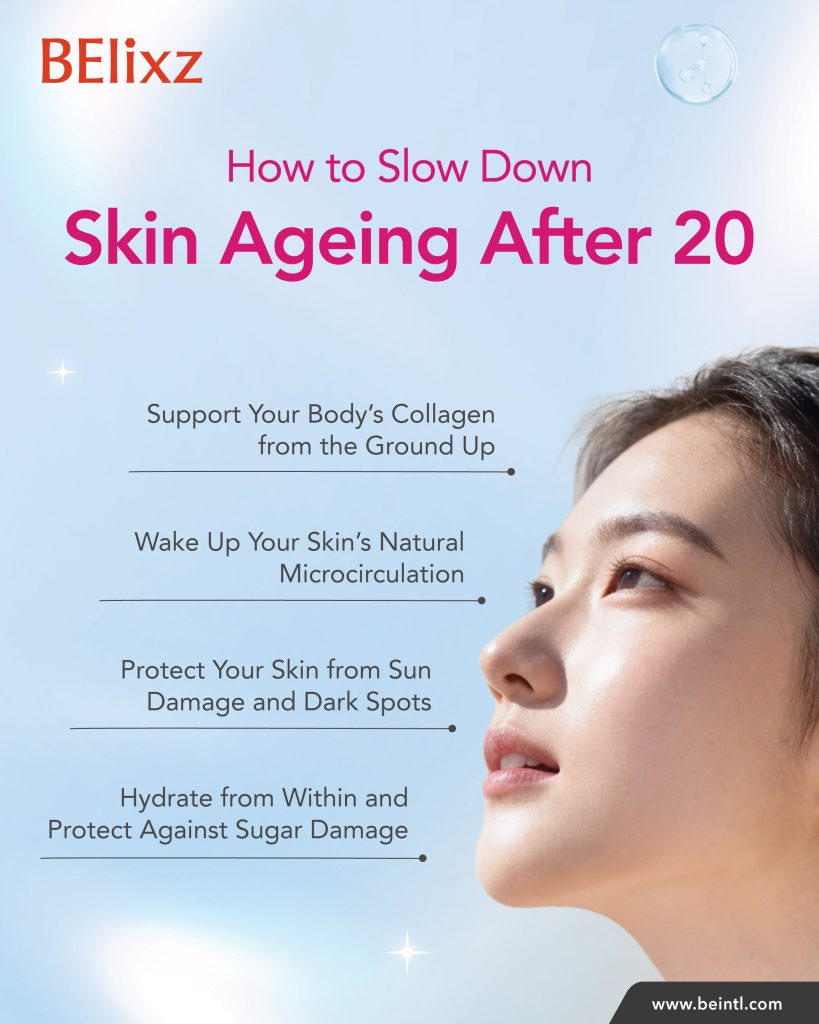
1. Support Your Body’s Collagen from the Ground Up
Collagen makes up 70–80% of your skin, serving as its structural foundation. Unfortunately, from the age of 20, our collagen levels decline by approximately 1.5% per year. By your 60s, you may have lost up to 50% of your total collagen, resulting in sagging and increased fragility.
To fight back, the latest innovation in anti-ageing supplements points toward Collagen Tripeptide (CTP) rather than Collagen Peptide (CP).
- Rapid Absorption: CTP has an ultra-small molecular size (<500 Da), allowing it to be absorbed in under 30 minutes, which is 4x faster than Collagen Peptide.
- Higher Bioavailability: It is 15x more bioavailable than Collagen Peptide.
2. Wake Up Your Skin’s Natural Microcirculation
As we age, skin microcirculation can decrease by up to 40%, slowing the delivery of oxygen and nutrients while allowing toxins to build up.
Bilberry Extract serves as a powerful ally against this decline. Rich in antioxidants like anthocyanidins and proanthocyanidins, it improves blood flow to refresh tired-looking skin and restore a healthy, radiant glow from the inside out.
3. Protect Your Skin from Sun Damage and Dark Spots
Long-term exposure to UV rays is one of the most aggressive factors. UV-A rays penetrate deep to damage collagen and elastin, while UV-B causes surface redness and pigmentation. However, your skin is also vulnerable to internal triggers.
Hormonal shifts driven by stress, menopause, perimenopause, or pregnancy can spike cortisol and estrogen levels. These fluctuations signal the body to overproduce melanin, resulting in increased pigmentation.
- Red Orange Extract: Targeting the external triggers, this Italian-sourced powerhouse can reduce UV-induced skin redness and cut melanin production.
- Olive & Licorice Extract: Helps clear your skin from the inside out. Their active ingredients, Hydroxytyrosol and Glycyrrhizin, calm inflammation and stop the overproduction of melanin caused by internal triggers like stress, ageing, and hormones.
4. Hydrate from Within and Protect Against Sugar Damage
Dull, lifeless skin is often a result of a weak skin barrier. Glycation is a process where excess sugar molecules bind to collagen, making it stiff and brittle.
- Phytoceramides: While Hyaluronic Acid is the gold standard for surface hydration, Phytoceramides from Wheat Extract act as the ‘internal glue’ that locks that moisture into the deeper layers of the dermis.
- Anti-Glycation: Olive and Licorice Extract help reduce Advanced Glycation End Products (AGEs), keeping skin supple rather than rough and wrinkled.
Restoring Your Youthful Bounce
Slowing down skin ageing after 20 isn’t just about what you put on your skin, but what you put into your body. By combining advanced nutrients like Collagen Tripeptide with protective botanical extracts, you can strengthen your skin’s barrier, clear pigmentation, and restore that elusive youthful bounce.
References:
- Cassinese, C., Gomila, S., & Tormo, M. A. (2007). The effect of olive and licorice extracts on glycation and melanin production. Fitoterapia, 78(3), 220–225.
- Choi, F. D., Sung, C. T., Juhasz, M. L., & Mesinkovsk, N. A. (2021). Oral collagen supplementation: A systematic review of dermatological applications. Journal of Cosmetic Dermatology, 20(1), 17–28.
- Hellstrom, J. K., Mattila, P. H., & Karjalainen, R. O. (2024). Anthocyanins in bilberry extract and their impact on microcirculation. Journal of Berry Research, 14(1), 12–25.
- Kwon, S. H., & Kim, B. J. (2022). Effects of oral intake of phytoceramides on skin barrier function. Nutrients, 14(12), 2415.
- Pugliese, A., Tomas-Barberan, F. A., & Truchado, P. (2013). Antioxidant activity of red orange extract in skin protection. Oxidative Medicine and Cellular Longevity, 2013, 745269.
- Sontakke, S., Jung, J., Padhye, S., & Ervene, J. (2016). Clinical efficacy of collagen tripeptide in skin elasticity and hydration. Journal of Functional Foods, 24, 45–52.
- Subramanian, A., & Nanthakumar, V. (2021). Role of collagen tripeptide in skin rejuvenation. Plastic and Aesthetic Research, 8, 22.
- Wang, Z., & Li, Y. (2019). Collagen tripeptide: A new anti-aging strategy. Aging and Disease, 10(6), 1215–1224.